
Hardware-Based Vision Therapy
Hardware-based vision therapy is an effective and painless method of training the visual system. The typical age range for patients undergoing hardware-based vision therapy is from 4 to 18 years, although in certain cases it is also recommended for adults, for example, during postoperative recovery.
Hardware-based vision therapy can be used for many disorders, such as:
- amblyopia (“lazy eye”);
- accommodative spasm;
- myopia (nearsightedness);
- hypermetropia (farsightedness);
- anisometropia (a significant difference in refractive power between the eyes);
- astigmatism;
- strabismus;
- asthenopia (eye strain).
The effectiveness of hardware-based vision therapy has been confirmed by many years of clinical practice: patients often experience an improvement in visual acuity and overall eye condition after the first course of procedures. The best results are achieved when the course is repeated every 4 months. This helps maintain the achieved outcome and prevent complications.
Key advantages of hardware-based vision therapy include safety, non-invasiveness, and a cumulative effect. All that is required is to undergo training using specialized devices. The sequence and number of devices are selected individually based on the diagnosis, age, and patient needs — but at least six devices are typically included.
How does it work?
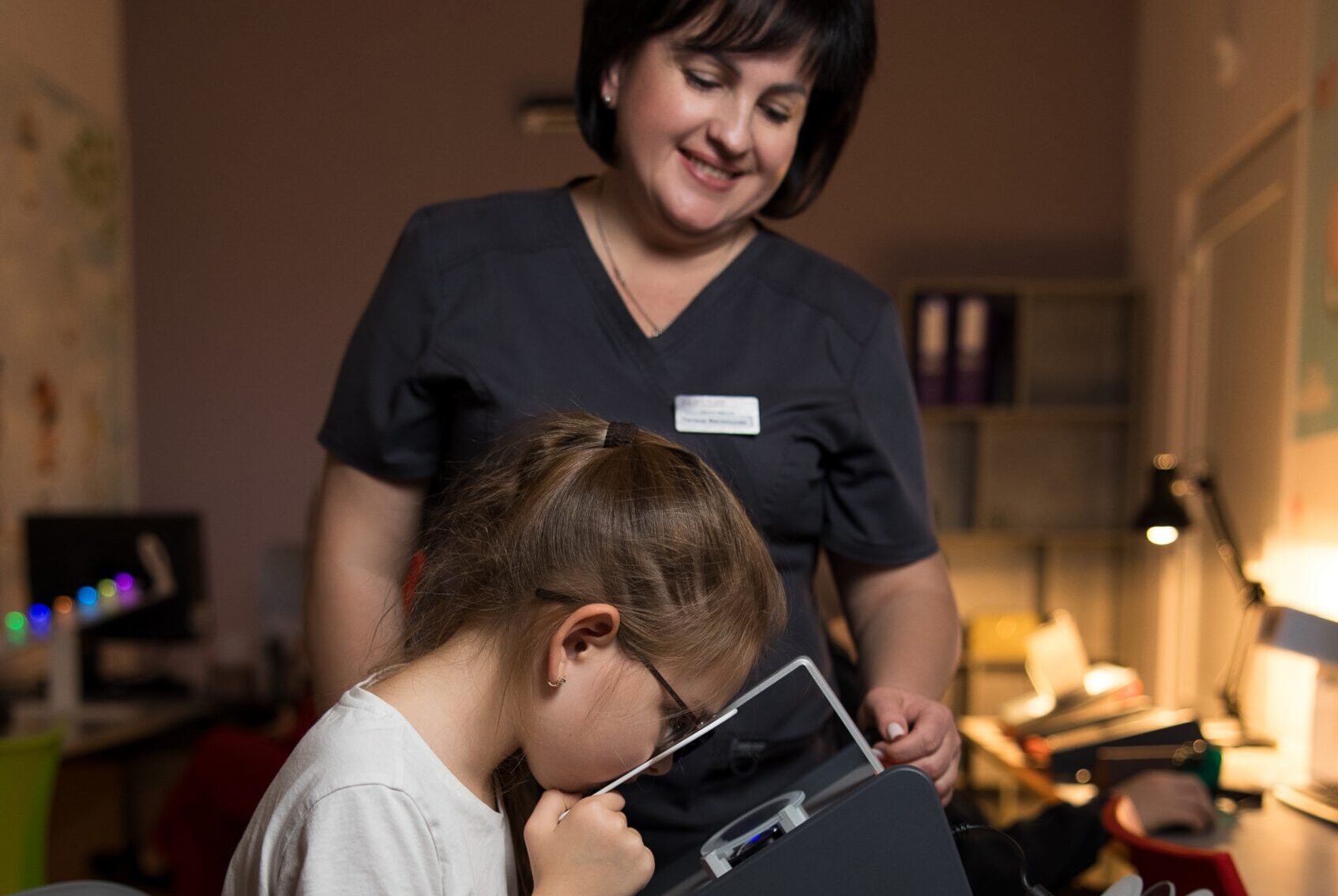
The “Prostir Zoru” clinic is equipped with modern devices for effective training of the eye muscles. Certain instruments, such as the Hess screen, also allow for highly accurate diagnostics to be performed simultaneously.
We prioritize a comprehensive approach: through visual stimuli, the eyes are “trained” to work together, while the brain develops new neural connections. The load is carefully dosed and controlled. In this way, the treatment targets the entire visual system, which is especially important during childhood.
In addition to improving visual acuity, hardware-based vision therapy also:
- helps reduce visual fatigue and eye muscle strain;
- enhances concentration and improves focusing ability;
- promotes coordinated binocular vision;
- optimizes the brain’s processing of visual information.
Frequently Asked Questions:
About 1 hour. The exact duration depends on the program and the patient.
The course lasts 10 days.
No, on the contrary — some procedures are light and even engaging.
Yes, it is recommended to undergo this therapy at least 2–3 times per year.
One session costs 400–500 UAH. Please уточняйте the exact price when booking an appointment.
No special preparation is needed. Please remember to bring your glasses if you wear them, as well as your most recent doctor’s report.
Trust your eye health to professionals — book a consultation at the PROSTIR ZORU clinic.