

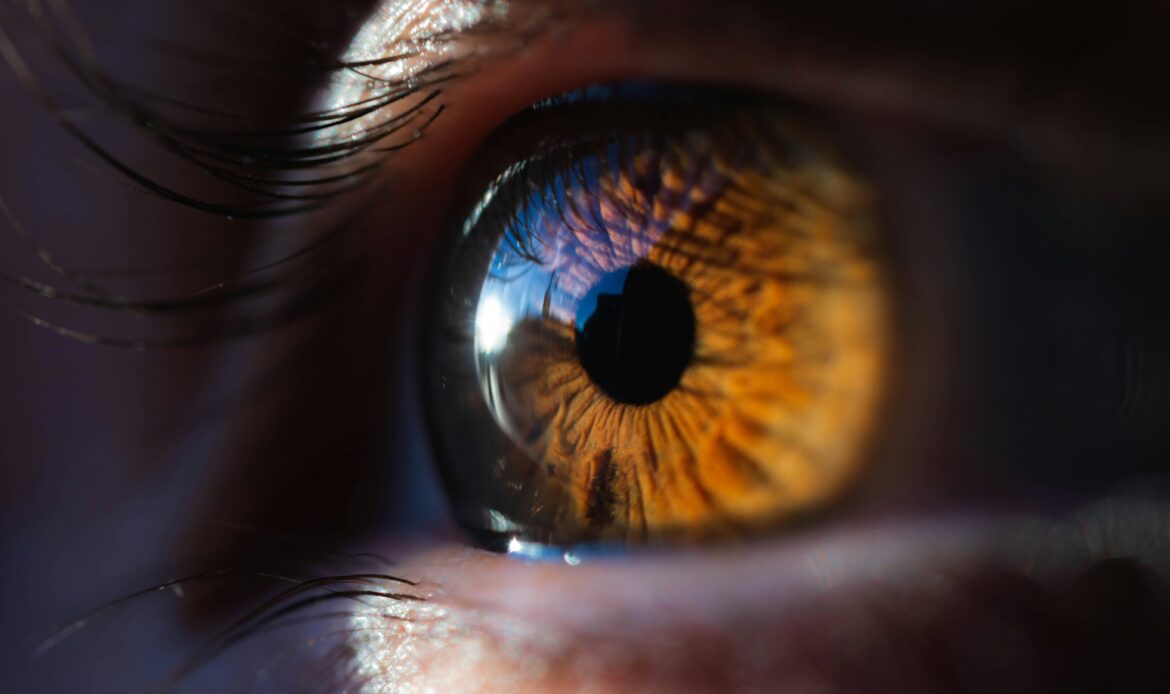
When we look in the mirror, we immediately see the iris and pupil, but it is the cornea—the transparent “window” in front of them—that makes vision possible.
The cornea is the transparent front layer of the eyeball through which sunlight enters. It serves two functions at the same time: protection against injury and infection, and refraction of light. It is the eye’s first barrier, protecting it from harmful external factors, from dust to ultraviolet radiation.
Normally, the cornea has the shape of a horizontal ellipse resembling a dome. Its geometrically precise structure consists of as many as six layers:
- epithelium,
- basement membrane,
- stroma (the thickest layer),
- Dua’s layer,
- descemet’s membrane,
- endothelium.
Among the interesting features of the cornea:
Absolute transparency.
This is the only completely transparent tissue in the human body. The collagen fibers in its middle layer (the stroma) are arranged so precisely and uniformly that light passes through them with virtually no scattering. If this arrangement is disrupted, for example by swelling, inflammation, or scarring, transparency is immediately lost and vision deteriorates.
Absence of blood vessels.
Even more interestingly, the cornea has no blood vessels at all. It is the only living tissue that “breathes” directly from the air and receives nutrients from the tear film on the outside and the aqueous humor from the inside.
Extreme sensitivity.
It also has an extremely dense network of nerve endings, making it one of the most sensitive tissues in the human body. That is why even the smallest speck of dust or an eyelash can cause pain. This is important because the cornea is so essential for vision that the body immediately signals any threat to it. However, there is also a positive side: the superficial epithelial layer of the cornea is capable of rapid regeneration. It is completely renewed every 7–10 days, while small scratches heal within a day to a day and a half. However, the same cannot be said about the endothelium – the cells a person is born with that line the inner surface of the cornea. With age, these cells are only gradually lost.
The main lens.
The cornea has significant optical power. It provides about two-thirds of the eye’s total refractive power – approximately 41–44 diopters. The crystalline lens has considerably less – 15–20 diopters when accommodation is at rest. That is why laser vision correction works specifically on the cornea and can provide very good results. Changing the curvature and thickness of the cornea by just a few microns can significantly improve vision. At the same time, the cornea is only about 550 microns thick in the center – thinner than a sheet of paper. A thin yet extremely strong structure.
A transplant that often succeeds.
Corneal transplantation (keratoplasty) is one of the most successful tissue transplant procedures in all of medicine. One of the reasons is the absence of blood vessels. Without direct access to the bloodstream, immune cells are less likely to “notice” the foreign tissue, so rejection occurs much less often than with transplantation of other organs. This phenomenon is known as immune privilege.
What diseases affect the cornea?
There are many diseases of the cornea, and they can have very different causes. Among them are:
- Keratitis. It may be viral, fungal, bacterial, parasitic, or traumatic.
- Keratoconus – a degenerative condition in which the cornea becomes thinner and takes on a cone-like shape, leading to visual impairment.
- Corneal dystrophies – a group of predominantly hereditary disorders in which the structure and transparency of the cornea are altered.
- Corneal degenerations – acquired changes that may be accompanied by deposits of lipids, calcium, or other structural abnormalities.
- Erosions and ulcers.
- Corneal edema – an accumulation of fluid in the corneal tissues, which may result from endothelial cell dysfunction, trauma, or previous surgical procedures.
- Endothelial corneal diseases – disorders affecting the cells of the inner layer of the cornea, such as Fuchs dystrophy.
- Injuries and burns – mechanical injuries, as well as chemical and thermal burns.
When should you see an ophthalmologist?
If you notice any of the following:
- pain or discomfort when blinking,
- increased sensitivity to light,
- burning or excessive tearing,
- redness of the eyes,
- a foreign body sensation or a feeling of “sand” in the eyes,
do not delay visiting an ophthalmologist. At Prostir Zoru Clinic, experienced doctors will provide a thorough examination and select the appropriate treatment. Taking care of your corneal health means taking care of the quality of your vision for years to come.

Kushnir Nataliya
Ophthalmologist, Candidate of Medical Sciences